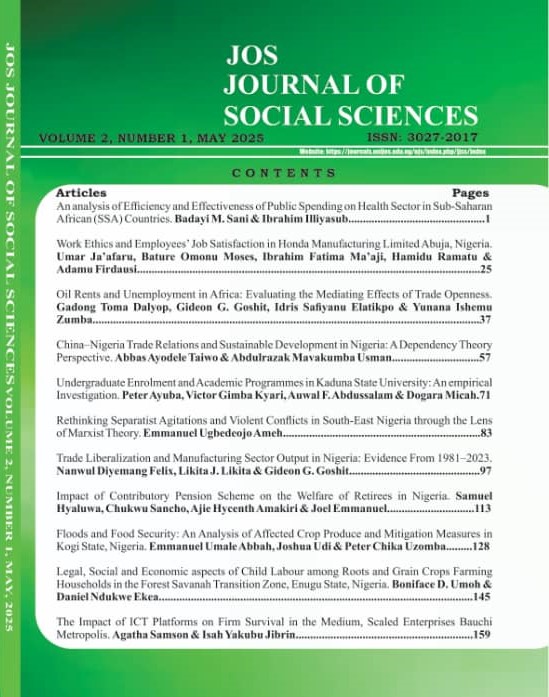
AN ANALYSIS OF EFFICIENCY AND EFFECTIVENESS OF PUBLIC SPENDING ON HEALTH SECTOR IN SUB-SAHARAN AFRICAN (SSA) COUNTRIES
Article Sidebar
Main Article Content
Abstract
Article Details
Section

This work is licensed under a Creative Commons Attribution-NonCommercial-ShareAlike 4.0 International License.
How to Cite
References
Adam, J.-P. (2018). The health sector in Seychelles: Prioritization and accountability. Health Systems & Reform, 4(4), 277–278. https://doi.org/10.1080/23288604.2018.1514560
Adegboye, A., & Akinyele, O. D. (2022). Assessing the determinants of government spending efficiency in Africa. Future Business Journal, 8(1), 47. https://doi.org/10.1186/s43093-022-00142-8
Afonso, A., & Aubyn, M. S. (2006a). Cross-country efficiency of secondary education provision: A semi-parametric analysis with non-discretionary inputs. Economic Modelling, 23(3), 476–491. https://www.sciencedirect.com/science/article/pii/S0264999306000149
Afonso, A., & Aubyn, M. S. (2006b). Relative efficiency of health provision: A DEA approach with non-discretionary inputs. Department of Economics, ISEG-UTL.
Afonso, A., & Aubyn, M. St. (2005). Non-Parametric Approaches to Education and Health Efficiency in OECD Countries. Journal of Applied Economics, 8(2), 227–246. https://doi.org/10.1080/15140326.2005.12040626
Afonso, A., & Fernandes, S. (2008). Assessing and explaining the relative efficiency of local government. The Journal of Socio-Economics, 37(5), 1946–1979. https://www.sciencedirect.com/science/article/pii/S105353570700073X
Afonso, A., Jalles, J. T., & Venâncio, A. (2021). Structural Tax Reforms and Public Spending Efficiency. Open Economies Review, 32(5), 1017–1061. https://doi.org/10.1007/s11079-021-09644-4
Afonso, A., Jalles, J. T., & Venâncio, A. (2023). Government spending efficiency, measurement and applications: A cross-country efficiency dataset. In Handbook on Public Sector Efficiency (pp. 44–71). Edward Elgar Publishing.
Afonso, A., Schuknecht, L., & Tanzi, V. (2005). Public sector efficiency: An international comparison. Public Choice, 123(3–4), 321–347. https://doi.org/10.1007/s11127-005-7165-2
Afonso, A., & St. Aubyn, M. (2011). Assessing health efficiency across countries with a two-step and bootstrap analysis. Applied Economics Letters, 18(15), 1427–1430. https://doi.org/10.1080/13504851.2010.541149
Agasisti, T. (2014). The Efficiency of Public Spending on Education: An empirical comparison of EU countries. European Journal of Education, 49(4), 543–557. https://doi.org/10.1111/ejed.12069
Ahmed, S., Hasan, Z. M., Maclennan, M., Dorin, F., Ahmed, W. M., Hasan, M. M., Hasan, M. S., Isalm, T. M., & Khan, J. A. (2019). Measuring the efficiency of health systems in Asia: A data envelopment analysis. BMJ Open, 1–12. http:// dx. doi. org/ 10. 1136/ bmjopen- 2018- 022155).
Antonelli, M. A., & De Bonis, V. (2019). The efficiency of social public expenditure in European countries: A two-stage analysis. Applied Economics, 51(1), 47–60. https://doi.org/10.1080/00036846.2018.1489522
Aubyn, M., Pina, A., Garcia, F., & Pais, J. (2009). Study on the efficiency and effectiveness of public spending on tertiary education Third report (second draft). European Commission-Directorate-General for Economic and Financial Affairs. https://www.repository.utl.pt/handle/10400.5/25846.
Avkiran, N. K. (2006). Developing foreign bank efficiency models for DEA grounded in finance theory. Socio-Economic Planning Sciences, 40(4), 275–296. https://doi.org/10.1016/j.seps.2004.10.006
Baldacci, E., Guin-Siu, M. T., & Mello, L. D. (2003). More on the effectiveness of public spending on health care and education: A covariance structure model. Journal of International Development, 15(6), 709–725. https://doi.org/10.1002/jid.1025
Banker, R., Charnes, A., & Cooper, W. W. (1984). Some Models for Estimating Technical and Scale Inefficiencies in Data Envelopment Analysis. Management Science, 30(9), 1078–1092. https://doi.org/10.1287/mnsc.30.9.1078
Batare, S. (2012). Efficiency of public spending on education. Viešoji Politika Ir Administravimas= Public Policy and Administration, 11(2), 171–186. https://cris.mruni.eu/cris/handle/007/10769
Beraldo, S., Montolio, D., & Turati, G. (2009). Healthy, educated and wealthy: A primer on the impact of public and private welfare expenditures on economic growth. The Journal of Socio-Economics, 38(6), 946–956. https://www.sciencedirect.com/science/article/pii/S1053535709000791
Charnes, A., Cooper, W. W., & Rhodes, E. (1978). Measuring the efficiency of decision making units. European Journal of Operational Research, 2(6), 429–444. https://sci-hub.se/https://doi.org/10.1016/0377-2217(78)90138-8
Clements, B. (2002). How efficient is education spending in Europe. European Review of Economics and Finance, 1(1), 3–26.
Davies, A. (2009). Human development and the optimal size of government—ScienceDirect. The Journal of Socio-Economics, 38(2), 326–330. https://doi.org/10.1016/j.socec.2008.07.015
Eneji, M. A., Dickson, V. J., & Onabe, B. J. (2013). Health care expenditure, health status and national productivity in Nigeria (1999-2012). https://irepos.unijos.edu.ng/jspui/handle/123456789/1741
European Commission EC. (2007). Efficiency and Effectiveness of Social Spending. Achievements and challenges. Background note for the informal ECOFIN of 4-.
Evans, D. B., Tandon, A., Murray, C. J., & Lauer, J. A. (2000). The comparative efficiency of national health systems in producing health: An analysis of 191 countries. World Health Organization, 29(29), 1–36. http://people.stern.nyu.edu/wgreene/Statistics/Sicko/WHO-DALE-Study-29.pdf
Farrell, M. J. (1957). The measurement of productive efficiency. Journal of the Royal Statistical Society Series A: Statistics in Society, 120(3), 253–281. https://academic.oup.com/jrsssa/article-abstract/120/3/253/7101561
Fonchamnyo, D. C., & Sama, M. C. (2016). Determinants of public spending efficiency in education and health: Evidence from selected CEMAC countries. Journal of Economics and Finance, 40(1), 199–210. https://doi.org/10.1007/s12197-014-9310-6
Gavurova, B., Kocisova, K., Belas, L., & Krajcik, V. (2017). Relative efficiency of government expenditure on secondary education. Journal of International Studies, 10(2), 329–343. https://doi.org/doi:10.14254/2071-8330.2017/10-2/23
Gomanee, K. (2005). Aid, public spending, and welfare: Evidence from quantile regressions. Journal of International Development, 17, 299–309.
Greenidge, K., & Stanford, S. (2007). What are the determinants of the health status in Latin America and the Caribbean. Central Bank of Barbados.
Gupta, S., Clements, B., & Inchauste, G. (Eds.). (2004). Helping countries develop: The role of fiscal policy. International Monetary Fund.
Gupta, S., & Verhoeven, M. (2001). The efficiency of government expenditure: Experiences from Africa. Journal of Policy Modeling, 23(4), 433–467. https://doi.org/10.1016/S0161-8938(00)00036-3
Gyimah-Brempong, K. (2011). Education and economic development in Africa. African Development Review, 23(2).
Haile, F., & Niño‐Zarazúa, M. (2018). Does Social Spending Improve Welfare in Low‐income and Middle‐income Countries? Journal of International Development, 30(3), 367–398. https://doi.org/10.1002/jid.3326
Hauner, & Kyobe, A. (2010). Determinants of Government Efficiency. World Development, 38(11), 1527-1542,. https://doi.org/doi:10.1016/j.worlddev.2010.04.004
Heathfield, D. F. (1976). Production Functions. In D. F. Heathfield (Ed.), Topics in Applied Macroeconomics (pp. 33–68). Macmillan Education UK. https://doi.org/10.1007/978-1-349-86197-2_2
Herrera, S., & Ouedraogo, A. (2018). Efficiency of public spending in education, health, and infrastructure: An international benchmarking exercise. https://papers.ssrn.com/sol3/papers.cfm?abstract_id=3249289
Herrera, S., & Pang, G. (2005). Efficiency of public spending in developing countries: An efficiency frontier approach (Vol. 3645). World Bank Publications.
Herrmann, P., Tausch, A., Heshmati, A., & Bajalan, C. S. (2008). Efficiency and effectiveness of social spending. https://papers.ssrn.com/sol3/papers.cfm?abstract_id=1136283
Humphrey, T. M. (1997). Algebraic production functions and their uses before Cobb- Douglas. Federal Reserve Bank of Richmond Economic Quarterly, 83(1), 51–83. http://ideas.repec.org/a/fip/fedreq/y1997iwinp51-83.html
Kabongo, W. N. S., & Mbonigaba, J. (2024). Public health spending in Sub‑Saharan Africa: Exploring transmission mechanisms using the latent growth curve mediation model. Health Economics Review, 14(14), 1–17. https://doi.org/10.1186/s13561-023-00472-5
Kabubo-Mariara, J., Ndenge, G., & Mwabu, D. K. (2009). Determinants of children’s nutritional status in Kenya: Evidence from demographic and health surveys. Journal of African Economies, 18(3), 363–387.
Kirigia, J. M., Emrouznejad, A., Vaz, R. G., Bastiene, H., & Padayachy, J. (2008). A comparative assessment of performance and productivity of health centres in Seychelles. International Journal of Productivity and Performance Management, 57(1), 72–92. https://doi.org/DOI 10.1108/17410400810841245
Koku, A. (2015). Efficiency of government expenditure in the ECOWAS Sub-region [PhD Thesis]. Master thesis, University Of Ghana, Ghana.
Koopmans, T. C. (1951). In An analysis of production as an efficient combination of activities. Wiley. https://cir.nii.ac.jp/crid/1572824499992043008
Liu, W., Xia, Y., & Hou, J. (2019). Health expenditure efficiency in rural China using the super-SBM model and the Malmquist productivity index. International Journal for Equity in Health, 18(1), 111. https://doi.org/10.1186/s12939-019-1003-5
Loikkanen, H., & Susiluoto, I. (2005). Cost efficiency of Finnish municipalities in basic service provision 1994-2022 [Mimeo].
Lovell, C. A. K. (1993). Production Frontiers and Productive Efficiency in H. Fried, CAK Lovell and H. Schmidt (eds) The Measurement of Productive Efficiency. Oxford University Press: Oxford.
Mandl, U., Dierx, A., & Ilzkovitz, F. (2008). The effectiveness and efficiency of public spending. Directorate General Economic and Financial Affairs (DG ECFIN), European …. https://ideas.repec.org/p/euf/ecopap/0301.html
Martins, S., & Veiga, F. J. (2014). Government size, composition of public expenditure, and economic development | International Tax and Public Finance. International Tax and Public Finance, 21, 578–597. https://doi.org/10.1007/s10797-014-9313-4
Mcintyre, D., Meheus, F., & Røttingen, J.-A. (2017). What level of domestic government health expenditure should we aspire to for universal health coverage? Health Economics, Policy and Law, 12(2), 125–137.
Mohanty, R. K., & Bhanumurthy, N. R. (2018). Assessing public expenditure efficiency at Indian states. https://www.nipfp.org.in/media/medialibrary/2018/03/WP_2018_225.pdf
Novignon, J. (2015). On the efficiency of public health expenditure in Sub-Saharan Africa: Does corruption and quality of public institutions matter? https://mpra.ub.uni-muenchen.de/id/eprint/39195
Novignon, J., & Lawanson, A. O. (2017). Health expenditure and child health outcomes in Sub-Saharan Africa. African Review of Economics and Finance, 9(1), 96–121. https://www.ajol.info/index.php/aref/article/view/162145
Ohikhuare, O., Oyewole, O., & Adedeji, A. (2022). Public Health Investment, Human Capital Accumulation, and Labour Productivity: Evidence from West Africa. Zagreb International Review of Economics & Business, 25(2), 139–163. https://hrcak.srce.hr/286092
Olanubi, S. O., & Olanubi, O. E. (2023). 19. Political short termism and government spending efficiency in Sub-Saharan Africa1. Handbook on Public Sector Efficiency, 430. https://ddd.uab.cat/pub/caplli/2023/ea12526bad29/AFONSO_9781839109157_2P.pdf#page=438
Olanubi, S. O., & Osode, O. E. (2017). The efficiency of government spending on health: A comparison of different administrations in Nigeria. Journal of Policy Modeling, 39(1), 79–98. https://www.sciencedirect.com/science/article/pii/S0161893816301016
Ouertani, M. N., Naifar, N., & Ben Haddad, H. (2018). Assessing government spending efficiency and explaining inefficiency scores: DEA-bootstrap analysis in the case of Saudi Arabia. Cogent Economics & Finance, 6(1), 1493666. https://doi.org/10.1080/23322039.2018.1493666
Pappas, P., & DePuy, V. (2004). An overview of non-parametric tests in SAS: When, why and how. Duke Clinical Research Institute.
Prasetyo, A. D., & Zuhdi, U. (2013). The government expenditure efficiency towards the human development. Procedia Economics and Finance, 5, 615–622. https://www.sciencedirect.com/science/article/pii/S2212567113000725
Productivity Commission PC. (2013). On efficiency and effectiveness: Some definitions. Productivity CommissionStaff Research Note -. https://www.pc.gov.au/research/supporting/efficiency-effectiveness
Puspitasari, E. D., & Pujiati, A. (2017). Analysis of efficiency of government expenditure in health sector in Central Java Province in 2012-2014. Economics Development Analysis Journal, 6(1), 30–39. https://journal.unnes.ac.id/sju/index.php/edaj/article/view/22198
Rajkumar, A. S., & Swaroop, V. (2008). Public spending and outcomes: Does governance matter? Journal of Development Economics, 86(1), 96–111. https://www.sciencedirect.com/science/article/pii/S0304387807000697
Sarri, S. (2011). Production and Productivity as Sources of Well-Being. MIDO. http://www.mido.fi/Index_tiedostot/Artikkeli%202011.htm
Shephard, R. W. (2015). Theory of Cost and Production Functions -. Princeton University Press. https://muse.jhu.edu/pub/267/monograph/book/39766
Sikayena, I., Bentum-Ennin, I., Andoh, F. K., & Asravor, R. (2022). Full article: Efficiency of public spending on human capital in Africa. Cogent Economics & Finance, 10(1), 1–15. https://doi.org/10.1080/23322039.2022.2140905
Silles, M. (2009). The causal effect of education on health: Evidence from the United Kingdom. Economics of Education Review, 28(1), 122–128.
Simar, L., & Wilson, P. W. (2007). Estimation and inference in two-stage, semi-parametric models of production processes. Journal of Econometrics, 136(1), 31–64. https://doi.org/10.1016/j.jeconom.2005.07.009
Stiefel, M. C., Perla, R. J., & Zell, B. L. (2010). A healthy bottom line: Healthy life expectancy as an outcome measure for health improvement efforts. Milbank Quarterly, 88(1), 30–53.
Streeten, P. (1994). Human development: Means and ends. The American Economic Review, 84(2), 232–237. https://www.jstor.org/stable/2117835
The Joint United Nations Programme on HIV/AIDS (UNAIDS). (2022). Global AIDS update. : https://www.unaids.org/en/resources/documents/2022/in-danger-globalaids-
Wandeda, D. O. (2021a). Government Expenditure, Efficiency, Institutional Quality and Economic Growth in Sub-saharan African Countries [PhD Thesis, University of Nairobi]. http://erepository.uonbi.ac.ke/handle/11295/157221
Wandeda, D. O. (2021b). Government Expenditure, Efficiency, Institutional Quality and Economic Growth in Sub-saharan African Countries [PhD Thesis, University of Nairobi]. http://erepository.uonbi.ac.ke/handle/11295/157221
Wang, M., & Tao, C. (2019). Research on the efficiency of local government health expenditure in China and its spatial spillover effect. Sustainability, 11(9), 2469. https://www.mdpi.com/2071-1050/11/9/2469
WDI. (2023). World development indicators [dataset]. https://databank.worldbank.org/source/world-development-indicators
Wicksteed, P. (1894). An Essay on the Co-ordination of the Laws of Distribution. Macmillan & Co. http://cepa.newschool.edu/het/texts/wicksteed/wickess.pdf
Widner, J. (2015). Human development in Africa. Perspectives on Politics, 3(3), 572–575.
Workie, N. W., Shroff, E., Yazbeck, A. S., Nguyen, S. N., & Karamagi, H. (2018). Who needs big health sector reforms anyway? Seychelles’ road to UHC provides lessons for Sub-Saharan Africa and Island Nations. Health Systems & Reform, 4(4), 362–371. https://doi.org/DOI: 10.1080/23288604.2018.1513265
World Health Organization WHO. (2018). Seychelles: Country cooperation strategy. http:// www.who.int/countries/en/
World Health Organization WHO. (2019). Cabo Verde shows us the healthcare progress we want to see across Africa. https://www.afro.who.int/news/cabo-verde-shows-us-health-care-progress-we-want-to-see-across-africa
World Health Organization WHO. (2022). Obesity rising in Africa: WHO analysis finds. https://www.afro.who.int/news/obesityrising- africa-who-analysis-finds
World Health Organization WHO. (2023). World malaria report (Tracking Progress and Gaps in the Global Response to Malaria). https://www.who.int/tems/global-malaria-report
World Health Organization WHO. (2024a). Health data overview for the Republic of Cabo Verde [dataset]. https://data.who.int/countries/132
World Health Organization WHO. (2024b). Health data overview for the Republic of Seychelles [dataset]. https://data.who.int/countries/69
World Health Organization WHO. (2024c). WHO certifies Cabo Verde as malaria-free, marking a historic milestone in the fight against malaria. https://www.who.int/news/item/12-01-2024-who-