
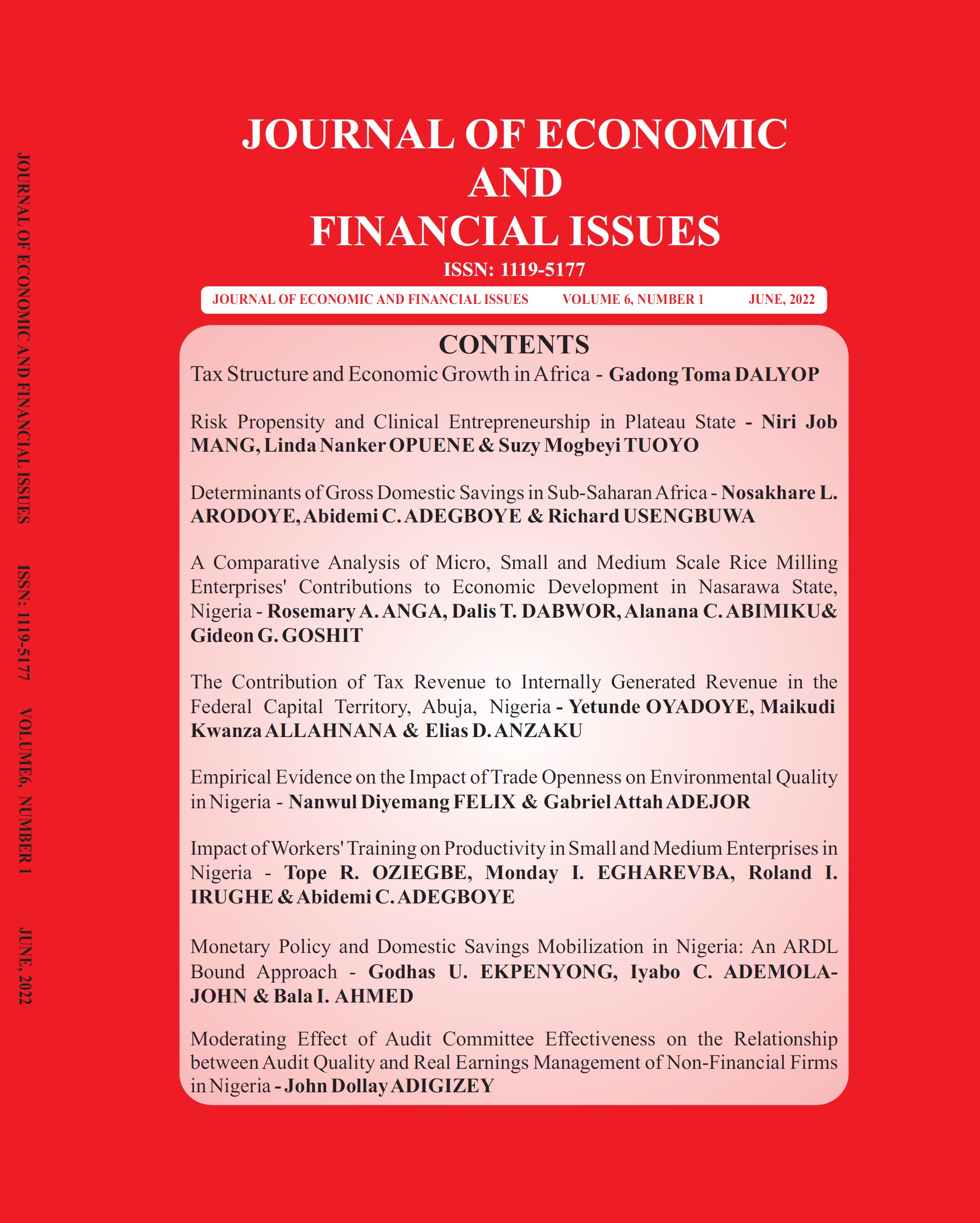
MODERATING EFFECT OF AUDIT COMMITTEE EFFECTIVENESS ON THE RELATIONSHIP BETWEEN AUDIT QUALITY AND REAL EARNINGS MANAGEMENT OF NON-FINANCIAL FIRMS IN NIGERIA
Keywords:
Audit-committee-effectiveness, Non-financial-firms, Audit quality, Real-earnings-management, JELClassification: C1, C10, C23, C52, M41, M42Abstract
Expectation for improvement in audit quality of firms has been on a rising trend in view of frequent cases of corporate scandals originating from managers' activities, viz-á-viz, the earnings management practices. This study examined the moderating effect of audit committee effectiveness on the relationship between audit quality and real earnings management of listed non-financial firms in Nigeria. Longitudinal research design was adopted with a study population of 116 non-financial companies quoted on the Nigeria Exchange Group (NGX), from which a sample of 50 firms was selected and data extracted from their audited annual reports for the period 2011-2020. Using EViews 9, the study employed multiple regression technique to analyze the data. Results showed that audit-committee-effectiveness had a significant moderating effect on the relationship between audit-firm-size, auditor-tenure and auditor-industry-specialization, and real earnings-management, but had no significant moderating effect on the relationship between audit-fees and real earnings-management. It was thus concluded that audit-committee-effectiveness facilitated monitoring activities over the auditor to ensure greater financial reporting quality. The study, therefore, recommended the need for companies, stakeholders, finance/accounting regulators, to consider an expanded approach in constraining real earnings management by ensuring that audit committee members have financial expertise to enhance their effectiveness.References
Adeyemi, S. B., Okpala, O., & Dabor, E. L. (2012). Factors affecting audit quality in Nigeria. International Journal of Business and Social Science, 3(20),198–209.
American Institute of Certified Public Accountants (AICPA) (2016). AICPA Code of Professional Conduct. American Institute of Certified Public Accountants, Inc.
Bae, G. S., & Lee, J. E. (2003). Does audit firm size matter? The effect of audit firm size measured by audit firm revenue, number of offices and professional headcounts on audit quality and audit fees. Journal of Accounting Research, 50(20), 10–17.
Balaciu, D., Bogdan, V. & Vladu, A. B. (2009). A brief review of creative accounting literature and its consequences in practice. Annales Universitatis Apulensis Series Oeconomica, 11(1), 170–182.
Bergen, D. V. (2013). Auditor industry specialization and audit quality: a longitudinal effect of auditor’s industry specialization on audit quality. A Master Thesis in the Department Accountancy, Tilburg School of Economics and Management, Tilburg University, Netherlands.
Companies and Allied Matters Act (CAMA). (2020). Retrieved on June 24, 2022, from https://www.cac.gov.ng/wp-content/uploads/2020/12/CAMA-NOTE-BOOK-FULL-VERSION.pdf
Clarke, T. (2007). International Corporate Governance: A Comparative Approach. Abingdon: Routledge.
Craven, B. M., & Marston, C. L. (1999). Financial reporting on the Internet by leading UK companies. European Accounting Review, 8(2), 321–333. https://doi.org/10.1080/096381899336069
Daily, C. M., Dalton, D. R., & Canella, A. A. (2003). Corporate governance: Decades of dialogue and data. The Academy of Management Review, 28(3): 371–383. https://doi.org/10.2307/30040727
Davis, J. H., Schoorman, F. D., & Donaldson, L. (1997). Toward a stewardship theory of management. Academy of Management Review, 22(1): 20–47. https://doi.org/10.5465/amr.1997.9707180258
DeAngelo, L. E. (1981). Auditor size and audit quality. Journal of Accounting and Economics, 3(3), 183–199.
DeFond, M. L., & Park, C. W. (2001). The reversal of abnormal accruals and the market valuation of earnings surprises. The Accounting Review, 76(3), 375–404. http://www.jstor.org/stable/3068941
Dhaliwal, D. S., (2007). The impact of earnings management and tax planning on the information content of earnings. SSRN Working Paper Series
Fields, T. D., Lys, T. Z., & Vincent, L. (2001). Empirical research on accounting choice. Journal of Accounting and Economics, 31(1-3), 255–307.
Goodstein, J., Gautam, K., & Boeker, W. (1994). The effects of board size and diversity on strategic change. Strategic Management Journal, 15(3), 241–250.
Gujarati, D. N. (2004). Basic Econometrics (4th ed.). McGraw-Hill Companies.
Hair, J., Black, W., Babin, B., Anderson, R., & Tatham, R. (2006). Multivariate Data Analysis (6th ed.). Upper Saddle River, NJ: Pearson Prentice Hall.
Healy, M. P., & Wahlen, M. J. (1999). A review of the earnings management literature and its implications for standard setting. Accounting Horizons, 13(4), 365–383.
Hermalin, B. E., & Weisbach, M. S. (2003) Boards of directors as an endogenously determined institution: A survey of the economic evidence. Economic Policy Review, 9, 7–26.
International Auditing and Assurance Standards Board (IAASB). (2011). Audit quality: An IAASB perspective. New York: International Auditing and Assurance Standards Board.
Jensen, M. C. (1993). The modern industrial revolution, exit, and the failure of internal control systems. Journal of Finance, 48(3), 831–880.
Jensen, M. C., & Meckling, W. H. (1976). The theory of firm: agency cost and ownership structure‖, Journal of Financial Economics, 3(4), 305–360.
Juhmani, O. (2017). Ownership structure and corporate voluntary disclosure: Evidence from Bahrain. International Journal of Accounting and Financial Reporting, 3(2), 133–148.
Junaidu, A. S., & Olanrewaju, A. (2018). Firm size, and audit quality of earnings management of quoted oil and gas marketing companies in Nigeria. Asian Journal of Multidisciplinary studies, 6(12), 2348–7186.
Lawrence, A., Minutti-Meza, M., & Zhang, P. (2011). Can Big 4 versus non-Big 4 difference in audit-quality proxies be attributed to client characteristics? The Accounting Review, 86(1), 259–286.
Levene, H. (1960). Robust tests for equality of variances. In: I. Olkin (Ed.), Contributions to Probability and Statistics. Palo Alto: Stanford University Press, 278–292.
Menon, K., & Williams, J. D. (1994). The use of audit committee for monitoring. Journal of Accounting and Public Policy, 13, 121–139.
Moizer, P. (1997). The meaning of auditing reports. Accounting and Business Research, 20(78), 111–121.
Mulford, C. W., & Comiskey, E. E. (2002). The financial numbers game: Detecting creative accounting practices. Wiley.
Muogbo, U. S. (2013). Impact of privatization on corporate performance: a study of selected industries in Nigeria. International Journal of Humanities and Social Science Invention, 2(7), 81–89.
Muogbo, O., Nneka, G., & Ikena, E. (2019). Effect of tenure of audit on earnings management of quoted firm in Nigeria. International Journal of Management and Social Science, 1(7).
Okolie, A. O. (2014). Accrual-based earnings management, corporate policies and managerial decisions of quoted companies in Nigeria. Research Journal of Finance and Accounting, 1–14.
Okolie, A. O., & Izedonmi, F. I. O. (2014). The impact of audit quality on the share prices of quoted companies in Nigeria. Research Journal of Finance and Accounting, 5(8), 150–166.
Owhoso, V. E., William F. M., & Lynch, J. G. (2002). Error detection by industry specialized teams during sequential audit review. Journal of Accounting Research, (40), 883–900. https://doi.org/10.1111/1475-679X.00075
Pouraghajan, A., Tabari, N. A. Y., Emamgholipour, M., & Mansourinia, E. (2013). The effect of audit quality on earnings management: evidence from Iran. International Journal of Basic Sciences and Applied Research, 2(4), 399–404.
Vafeas, N. (2005). The association between corporate boards, audit committees, and management earnings forecasts: An empirical analysis. Journal of Accounting Research, 43 (3), 453–486.
Pincus, K., Rusbarsky, M., & Wong, J. (1989). Voluntary formation of corporate audit committees among NASDAQ Firms, Journal of Accounting and Public Policy, 8(4), 239–265.
Ramadan, I. Z. (2015). Earnings Quality Determinants of the Jordanian Manufacturing Listed Companies. International Journal of Economics and Finance, 7(5), 140–146. https://doi.org/10.5539/ijef.v7n5p140
Robu, I. -B., Chersan, I. -C., Mironiuc, M., & Carp, M. (2012). Empirical study on the assessment of the auditor’s responsibility regarding the risk of financial fraud. Communications of the IBIMA, May 2014, 1–17. https://doi.org/10.5171/2012.216771
Sari, S. (2018). The relationship between information asymmetry and mechanisms of corporate governance of companies in Tehran stock exchange. Procedia-Social and Behavioral Sciences, 205, 505–509.
Solomon, I., Shields, M., & Whittington, R. (1999). What do industry-specialist auditors know? Journal of Accounting Research, 37. https://doi.org/10.2307/2491403.
Padilla, A. (2002). Can agency theory justify the regulation of insider trading? The Quarterly Journal of Austrian Economics, 5(1), 3-38. https://doi.org/10.1007/s12113-002-1015-6
Pierre, K., & Anderson, J. (1984). An analysis of factors associated with lawsuits against public accountants. The Accounting Review, 59 (2), 242–263.
Smith, A. (1776). An inquiry into the wealth of nations. London: Strahan and Cadell.
Stice, J. D. (1991). Using financial and market information to identify pre-engagement factor associated with lawsuits against auditors. The Accounting Review, 66 (3), 516–533.
Teoh, S. H., & Wong, T. J. (1993). Perceived auditor quality and earnings response co-efficient. The Accounting Review, 68(2), 346–366.
Tucker, J. W., & Zarowin, P. A. (2006). Does income smoothing improve earnings informativeness? The Accounting Review, 81(1), 251–270.
Watkins, A. L., Hillison, W., & Morecroft, S. E. (2004). Audit quality: a synthesis of theory and empirical evidence. Journal of Accounting Literature, 23, 153–193.
Yamane, Taro. (1967). Statistics: An Introductory Analysis (2nd ed.). New York: Harper and Row.
Yermack, D. (1996). Higher market valuation of companies with a small board of directors. Journal of Financial Economics, 40, 185–212.
Downloads
Published
Issue
Section
License
Copyright (c) 2022 JOURNAL OF ECONOMICS AND FINANCIAL ISSUES

This work is licensed under a Creative Commons Attribution-ShareAlike 4.0 International License.
