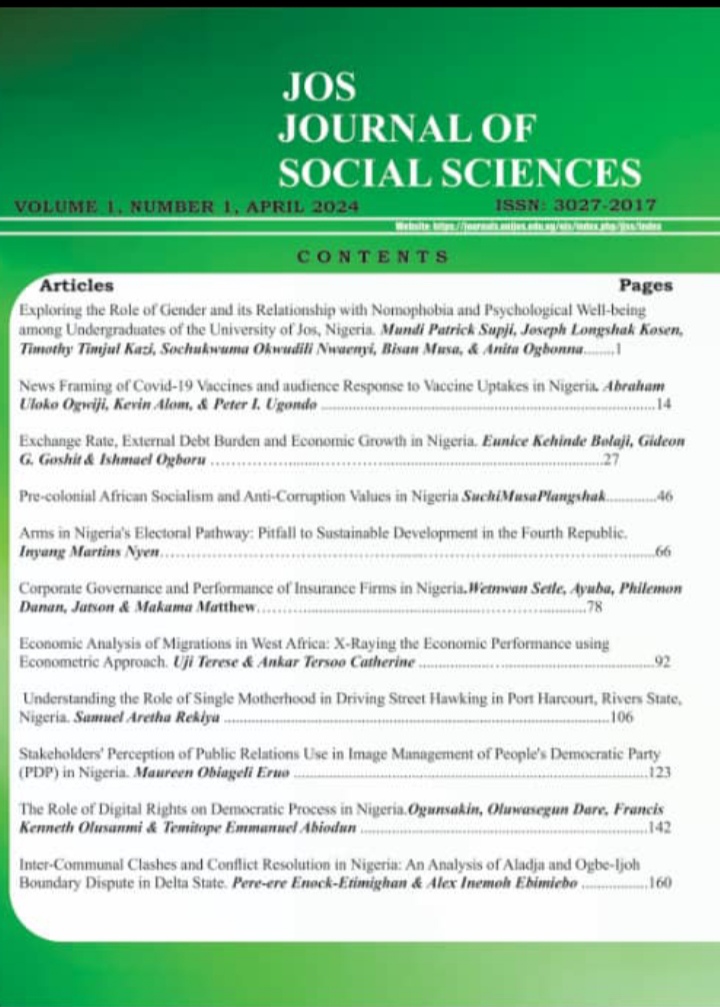
EXPLORING THE ROLE OF GENDER AND ITS RELATIONSHIP WITH NOMOPHOBIA AND PSYCHOLOGICAL WELL-BEING AMONG UNDERGRADUATES OF THE UNIVERSITY OF JOS, NIGERIA
Keywords:
Gender, Nomophobia, Psychological Well-being, Undergraduates.Abstract
This study examined the role of gender and its relationship with nomophobia and
psychological well-being among undergraduates of the University of Jos, Nigeria.
One hundred and twenty (120) students, consented to participate in the study,
comprising 64 males and 56 females (N=56), ranging in age between 16 to 35 years.
The Nomophobia Questionnaire (Yildirim & Correia, 2015) and the Psychological
Well-being Scale (Ryff, 1989), were used to collect data for testing two (2)
hypotheses. The test results indicated a negative correlation between nomophobia
and psychological well-being of undergraduate students, while nomophobia had no
significant relationship with psychological well-being, but there was a significant
positive relationship between gender and psychological well-being. However,
gender did not significantly moderate the relationship between nomophobia and
psychological well-being. Based on these findings, it was recommended that
counsellors and management of universities should as a matter of policy, counsel
students on the safe use of their smart-phones in order to improve their psychological
wellbeing and overall quality of life
References
REFRENCES
Abdoli, N., Sadeghi- Bahmani, D., Salari, N., Khodamoradi, M., Farnia, V.,
Jahangari, S., Bruhl, A. B., Dursteler, K. M., Stanga, Z. & Brand, S. (2023).
Nomophobia (no mobile phone phobia) and psychological health issues
among young adult students. ResearchGate, 13, 1762-1775.
Abdullahi, A. M., Muhammad, A. M., & Muhammad, A. S. (2020). Prevalence of
nomophobia among postgraduate university students in Kaduna State,
Nigeria. Kano Journal of Educational Psychology, 2(2), 2736-1373.
Adnan, M., & Gezgin, D. M. (2016). A modern phobia: Prevalence of nomophobia
among college students. Ankara University Journal, Faculty of Educational
Sciences, 49(1), 141-158. https://doi.org/10.1501/Egifak_0000001378.
Ainsworth, M. D., Blehar, M. C., Waters, E., & Wall, S. (1978). Patterns of
attachment: A psychological study of strange the situation. APA PsychNet.
Bartwal, J. & Nath, B. (2020). Evaluating nomophobia among medical students
using smarthphones in North India. Medical Journal of Armed Forces, 76(4),
451-455
Bhattacharya, S., Bashsr, M. A., Srivastava, A. & Singh, A, (2019) NOMOPHOBIA:
NO Mobile Phone phoBIA. Journal of Family Medicine and Primary Care,
8(4), 1297-1300
Bowlby, L. (1958). The nature of the child tie to his mother. International Journal of
Psychanalysis, 39, 350-371
Burns, R. A. (2017). Psychological well-being. In: Pachana N. A. (ed.).
Encyclopedia of geropsychology. Springer. ResearchGate.
Davies, C. (2018). Nomophobia: The modern-day pathology. Psychiatry Advisor.
Gezgin, D. M. and Ummet, D. (2021). An investigation into the relationship between
omophobia and social and emotional loneliness of Turkish University
students. International Journal of Psychological and Educational Studies,
8(2), 14-26
Kubrusly, M. Silva, P. G. B., Vasconceios, G. V., Deiano, E. D. L. G., Santos, P. &
Rocha, H. L. (2021). Nomophobia among medical students and its
association with depression, anxiety, stress and academic performance.
Research Gate, 45(3).
Mcleod, S. (2024). Attachment theory in psychology. Simply Psychology.
simplypsychology.org/attachment.html
Okoye,C. A., Harry, H. O. & Obikwelu, V. C. (2017). Nomophobia among
undergraduate: Predictive influence of personality traits. Pracicum
Psychologia, 7(2), 64-74
Ozdemir, B, Cakir, O. & Hussain, I. (2018). Prevalence of Nomophobia among
university students: A comparative study of Pakistani and Turkish
undergraduate students. Eurasia J. Math. Sci. Technol. Ed., 14, 1519 - 1532.
Pavithra, M. B., Madhukumar, S., & Murthy, M. (2015). A study on nomophobiamobile
phone dependence, among students at a medical college in Banglore.
National Journal of Community Medicine, 6(3), 340-344.
Ryff, C. (1989). Happiness is everything, or is it? Exploration on the meaning of
psychological well-being. Journal of Personality and Social Psychology, 57,
1069-1081.
Ryff, C. D., & Keyes, C. L. M. (1995). The structure of psychological well-being
revisited. Journal of Personality and Social Psychology, 69(4), 719-727.
Thomee,S., Harenstam, A., & Hagberg, M. (2011). Mobile phone use and stress,
sleep disturbances and symptoms of depression among young adults-a
prospective cohort study. BMC Public Health, 11(66), 11-66.
Yildirim, Ç., & Correia, A. P. (2015). Exploring the dimensions of nomophobia:
Development and validation of self-reported questionnaire. Computers in
Human Behaviours, 49, 130-137.
Yildirim, C., Sumuer, E., Adnan, M., & Yildirim, S. (2015). A growing fear:
Prevalence of nomophobia among Turkish College Students. Information
Development, 32 (5), 1322-1331. https://doi.org/10.1177/0266666915599025.