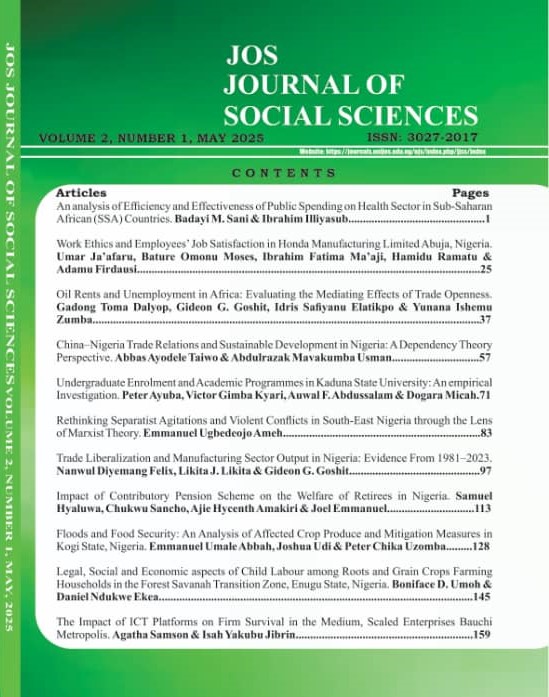
AN ANALYSIS OF EFFICIENCY AND EFFECTIVENESS OF PUBLIC SPENDING ON HEALTH SECTOR IN SUB-SAHARAN AFRICAN (SSA) COUNTRIES
Keywords:
Efficiency, Effectiveness, Public health spending, JEL Classification: C14, C34, H51Abstract
This paper examined the efficiency and effectiveness of public health spending in a sample of 46 SSA countries over 2000-2010 and 2011-2022 periods. The study employed Data Envelopment Analysis (DEA), Tobit regression, Simar-Wilson Bootstrap (algorithm #1) and cross-sectional regression. The main results revealed that: (i) average SSA countries public health spending efficiency scores were 0.857 and 0.900 in the two periods. (ii) Cape Verde and Seychelles were consistently efficient and (iii) average public health spending efficiency scores were virtually the same across income level, resource abundance, conflict and fragile as well as colonial legacy countries groupings. The study argued that the region could have achieved about 14% and 10% more additional health outcomes while using same amount of resources. The study, therefore, suggested that better public health care outcomes could be achieved in SSA by improving health sector regulatory framework, guided urbanization growth as well as strengthening HIV-AIDS, malaria and obesity control effort.References
Adam, J.-P. (2018). The health sector in Seychelles: Prioritization and accountability. Health Systems & Reform, 4(4), 277–278. https://doi.org/10.1080/23288604.2018.1514560
Adegboye, A., & Akinyele, O. D. (2022). Assessing the determinants of government spending efficiency in Africa. Future Business Journal, 8(1), 47. https://doi.org/10.1186/s43093-022-00142-8
Afonso, A., & Aubyn, M. S. (2006a). Cross-country efficiency of secondary education provision: A semi-parametric analysis with non-discretionary inputs. Economic Modelling, 23(3), 476–491. https://www.sciencedirect.com/science/article/pii/S0264999306000149
Afonso, A., & Aubyn, M. S. (2006b). Relative efficiency of health provision: A DEA approach with non-discretionary inputs. Department of Economics, ISEG-UTL.
Afonso, A., & Aubyn, M. St. (2005). Non-Parametric Approaches to Education and Health Efficiency in OECD Countries. Journal of Applied Economics, 8(2), 227–246. https://doi.org/10.1080/15140326.2005.12040626
Afonso, A., & Fernandes, S. (2008). Assessing and explaining the relative efficiency of local government. The Journal of Socio-Economics, 37(5), 1946–1979. https://www.sciencedirect.com/science/article/pii/S105353570700073X
Afonso, A., Jalles, J. T., & Venâncio, A. (2021). Structural Tax Reforms and Public Spending Efficiency. Open Economies Review, 32(5), 1017–1061. https://doi.org/10.1007/s11079-021-09644-4
Afonso, A., Jalles, J. T., & Venâncio, A. (2023). Government spending efficiency, measurement and applications: A cross-country efficiency dataset. In Handbook on Public Sector Efficiency (pp. 44–71). Edward Elgar Publishing.
Afonso, A., Schuknecht, L., & Tanzi, V. (2005). Public sector efficiency: An international comparison. Public Choice, 123(3–4), 321–347. https://doi.org/10.1007/s11127-005-7165-2
Afonso, A., & St. Aubyn, M. (2011). Assessing health efficiency across countries with a two-step and bootstrap analysis. Applied Economics Letters, 18(15), 1427–1430. https://doi.org/10.1080/13504851.2010.541149
Agasisti, T. (2014). The Efficiency of Public Spending on Education: An empirical comparison of EU countries. European Journal of Education, 49(4), 543–557. https://doi.org/10.1111/ejed.12069
Ahmed, S., Hasan, Z. M., Maclennan, M., Dorin, F., Ahmed, W. M., Hasan, M. M., Hasan, M. S., Isalm, T. M., & Khan, J. A. (2019). Measuring the efficiency of health systems in Asia: A data envelopment analysis. BMJ Open, 1–12. http:// dx. doi. org/ 10. 1136/ bmjopen- 2018- 022155).
Antonelli, M. A., & De Bonis, V. (2019). The efficiency of social public expenditure in European countries: A two-stage analysis. Applied Economics, 51(1), 47–60. https://doi.org/10.1080/00036846.2018.1489522
Aubyn, M., Pina, A., Garcia, F., & Pais, J. (2009). Study on the efficiency and effectiveness of public spending on tertiary education Third report (second draft). European Commission-Directorate-General for Economic and Financial Affairs. https://www.repository.utl.pt/handle/10400.5/25846.
Avkiran, N. K. (2006). Developing foreign bank efficiency models for DEA grounded in finance theory. Socio-Economic Planning Sciences, 40(4), 275–296. https://doi.org/10.1016/j.seps.2004.10.006
Baldacci, E., Guin-Siu, M. T., & Mello, L. D. (2003). More on the effectiveness of public spending on health care and education: A covariance structure model. Journal of International Development, 15(6), 709–725. https://doi.org/10.1002/jid.1025
Banker, R., Charnes, A., & Cooper, W. W. (1984). Some Models for Estimating Technical and Scale Inefficiencies in Data Envelopment Analysis. Management Science, 30(9), 1078–1092. https://doi.org/10.1287/mnsc.30.9.1078
Batare, S. (2012). Efficiency of public spending on education. Viešoji Politika Ir Administravimas= Public Policy and Administration, 11(2), 171–186. https://cris.mruni.eu/cris/handle/007/10769
Beraldo, S., Montolio, D., & Turati, G. (2009). Healthy, educated and wealthy: A primer on the impact of public and private welfare expenditures on economic growth. The Journal of Socio-Economics, 38(6), 946–956. https://www.sciencedirect.com/science/article/pii/S1053535709000791
Charnes, A., Cooper, W. W., & Rhodes, E. (1978). Measuring the efficiency of decision making units. European Journal of Operational Research, 2(6), 429–444. https://sci-hub.se/https://doi.org/10.1016/0377-2217(78)90138-8
Clements, B. (2002). How efficient is education spending in Europe. European Review of Economics and Finance, 1(1), 3–26.
Davies, A. (2009). Human development and the optimal size of government—ScienceDirect. The Journal of Socio-Economics, 38(2), 326–330. https://doi.org/10.1016/j.socec.2008.07.015
Eneji, M. A., Dickson, V. J., & Onabe, B. J. (2013). Health care expenditure, health status and national productivity in Nigeria (1999-2012). https://irepos.unijos.edu.ng/jspui/handle/123456789/1741
European Commission EC. (2007). Efficiency and Effectiveness of Social Spending. Achievements and challenges. Background note for the informal ECOFIN of 4-.
Evans, D. B., Tandon, A., Murray, C. J., & Lauer, J. A. (2000). The comparative efficiency of national health systems in producing health: An analysis of 191 countries. World Health Organization, 29(29), 1–36. http://people.stern.nyu.edu/wgreene/Statistics/Sicko/WHO-DALE-Study-29.pdf
Farrell, M. J. (1957). The measurement of productive efficiency. Journal of the Royal Statistical Society Series A: Statistics in Society, 120(3), 253–281. https://academic.oup.com/jrsssa/article-abstract/120/3/253/7101561
Fonchamnyo, D. C., & Sama, M. C. (2016). Determinants of public spending efficiency in education and health: Evidence from selected CEMAC countries. Journal of Economics and Finance, 40(1), 199–210. https://doi.org/10.1007/s12197-014-9310-6
Gavurova, B., Kocisova, K., Belas, L., & Krajcik, V. (2017). Relative efficiency of government expenditure on secondary education. Journal of International Studies, 10(2), 329–343. https://doi.org/doi:10.14254/2071-8330.2017/10-2/23
Gomanee, K. (2005). Aid, public spending, and welfare: Evidence from quantile regressions. Journal of International Development, 17, 299–309.
Greenidge, K., & Stanford, S. (2007). What are the determinants of the health status in Latin America and the Caribbean. Central Bank of Barbados.
Gupta, S., Clements, B., & Inchauste, G. (Eds.). (2004). Helping countries develop: The role of fiscal policy. International Monetary Fund.
Gupta, S., & Verhoeven, M. (2001). The efficiency of government expenditure: Experiences from Africa. Journal of Policy Modeling, 23(4), 433–467. https://doi.org/10.1016/S0161-8938(00)00036-3
Gyimah-Brempong, K. (2011). Education and economic development in Africa. African Development Review, 23(2).
Haile, F., & Niño‐Zarazúa, M. (2018). Does Social Spending Improve Welfare in Low‐income and Middle‐income Countries? Journal of International Development, 30(3), 367–398. https://doi.org/10.1002/jid.3326
Hauner, & Kyobe, A. (2010). Determinants of Government Efficiency. World Development, 38(11), 1527-1542,. https://doi.org/doi:10.1016/j.worlddev.2010.04.004
Heathfield, D. F. (1976). Production Functions. In D. F. Heathfield (Ed.), Topics in Applied Macroeconomics (pp. 33–68). Macmillan Education UK. https://doi.org/10.1007/978-1-349-86197-2_2
Herrera, S., & Ouedraogo, A. (2018). Efficiency of public spending in education, health, and infrastructure: An international benchmarking exercise. https://papers.ssrn.com/sol3/papers.cfm?abstract_id=3249289
Herrera, S., & Pang, G. (2005). Efficiency of public spending in developing countries: An efficiency frontier approach (Vol. 3645). World Bank Publications.
Herrmann, P., Tausch, A., Heshmati, A., & Bajalan, C. S. (2008). Efficiency and effectiveness of social spending. https://papers.ssrn.com/sol3/papers.cfm?abstract_id=1136283
Humphrey, T. M. (1997). Algebraic production functions and their uses before Cobb- Douglas. Federal Reserve Bank of Richmond Economic Quarterly, 83(1), 51–83. http://ideas.repec.org/a/fip/fedreq/y1997iwinp51-83.html
Kabongo, W. N. S., & Mbonigaba, J. (2024). Public health spending in Sub‑Saharan Africa: Exploring transmission mechanisms using the latent growth curve mediation model. Health Economics Review, 14(14), 1–17. https://doi.org/10.1186/s13561-023-00472-5
Kabubo-Mariara, J., Ndenge, G., & Mwabu, D. K. (2009). Determinants of children’s nutritional status in Kenya: Evidence from demographic and health surveys. Journal of African Economies, 18(3), 363–387.
Kirigia, J. M., Emrouznejad, A., Vaz, R. G., Bastiene, H., & Padayachy, J. (2008). A comparative assessment of performance and productivity of health centres in Seychelles. International Journal of Productivity and Performance Management, 57(1), 72–92. https://doi.org/DOI 10.1108/17410400810841245
Koku, A. (2015). Efficiency of government expenditure in the ECOWAS Sub-region [PhD Thesis]. Master thesis, University Of Ghana, Ghana.
Koopmans, T. C. (1951). In An analysis of production as an efficient combination of activities. Wiley. https://cir.nii.ac.jp/crid/1572824499992043008
Liu, W., Xia, Y., & Hou, J. (2019). Health expenditure efficiency in rural China using the super-SBM model and the Malmquist productivity index. International Journal for Equity in Health, 18(1), 111. https://doi.org/10.1186/s12939-019-1003-5
Loikkanen, H., & Susiluoto, I. (2005). Cost efficiency of Finnish municipalities in basic service provision 1994-2022 [Mimeo].
Lovell, C. A. K. (1993). Production Frontiers and Productive Efficiency in H. Fried, CAK Lovell and H. Schmidt (eds) The Measurement of Productive Efficiency. Oxford University Press: Oxford.
Mandl, U., Dierx, A., & Ilzkovitz, F. (2008). The effectiveness and efficiency of public spending. Directorate General Economic and Financial Affairs (DG ECFIN), European …. https://ideas.repec.org/p/euf/ecopap/0301.html
Martins, S., & Veiga, F. J. (2014). Government size, composition of public expenditure, and economic development | International Tax and Public Finance. International Tax and Public Finance, 21, 578–597. https://doi.org/10.1007/s10797-014-9313-4
Mcintyre, D., Meheus, F., & Røttingen, J.-A. (2017). What level of domestic government health expenditure should we aspire to for universal health coverage? Health Economics, Policy and Law, 12(2), 125–137.
Mohanty, R. K., & Bhanumurthy, N. R. (2018). Assessing public expenditure efficiency at Indian states. https://www.nipfp.org.in/media/medialibrary/2018/03/WP_2018_225.pdf
Novignon, J. (2015). On the efficiency of public health expenditure in Sub-Saharan Africa: Does corruption and quality of public institutions matter? https://mpra.ub.uni-muenchen.de/id/eprint/39195
Novignon, J., & Lawanson, A. O. (2017). Health expenditure and child health outcomes in Sub-Saharan Africa. African Review of Economics and Finance, 9(1), 96–121. https://www.ajol.info/index.php/aref/article/view/162145
Ohikhuare, O., Oyewole, O., & Adedeji, A. (2022). Public Health Investment, Human Capital Accumulation, and Labour Productivity: Evidence from West Africa. Zagreb International Review of Economics & Business, 25(2), 139–163. https://hrcak.srce.hr/286092
Olanubi, S. O., & Olanubi, O. E. (2023). 19. Political short termism and government spending efficiency in Sub-Saharan Africa1. Handbook on Public Sector Efficiency, 430. https://ddd.uab.cat/pub/caplli/2023/ea12526bad29/AFONSO_9781839109157_2P.pdf#page=438
Olanubi, S. O., & Osode, O. E. (2017). The efficiency of government spending on health: A comparison of different administrations in Nigeria. Journal of Policy Modeling, 39(1), 79–98. https://www.sciencedirect.com/science/article/pii/S0161893816301016
Ouertani, M. N., Naifar, N., & Ben Haddad, H. (2018). Assessing government spending efficiency and explaining inefficiency scores: DEA-bootstrap analysis in the case of Saudi Arabia. Cogent Economics & Finance, 6(1), 1493666. https://doi.org/10.1080/23322039.2018.1493666
Pappas, P., & DePuy, V. (2004). An overview of non-parametric tests in SAS: When, why and how. Duke Clinical Research Institute.
Prasetyo, A. D., & Zuhdi, U. (2013). The government expenditure efficiency towards the human development. Procedia Economics and Finance, 5, 615–622. https://www.sciencedirect.com/science/article/pii/S2212567113000725
Productivity Commission PC. (2013). On efficiency and effectiveness: Some definitions. Productivity CommissionStaff Research Note -. https://www.pc.gov.au/research/supporting/efficiency-effectiveness
Puspitasari, E. D., & Pujiati, A. (2017). Analysis of efficiency of government expenditure in health sector in Central Java Province in 2012-2014. Economics Development Analysis Journal, 6(1), 30–39. https://journal.unnes.ac.id/sju/index.php/edaj/article/view/22198
Rajkumar, A. S., & Swaroop, V. (2008). Public spending and outcomes: Does governance matter? Journal of Development Economics, 86(1), 96–111. https://www.sciencedirect.com/science/article/pii/S0304387807000697
Sarri, S. (2011). Production and Productivity as Sources of Well-Being. MIDO. http://www.mido.fi/Index_tiedostot/Artikkeli%202011.htm
Shephard, R. W. (2015). Theory of Cost and Production Functions -. Princeton University Press. https://muse.jhu.edu/pub/267/monograph/book/39766
Sikayena, I., Bentum-Ennin, I., Andoh, F. K., & Asravor, R. (2022). Full article: Efficiency of public spending on human capital in Africa. Cogent Economics & Finance, 10(1), 1–15. https://doi.org/10.1080/23322039.2022.2140905
Silles, M. (2009). The causal effect of education on health: Evidence from the United Kingdom. Economics of Education Review, 28(1), 122–128.
Simar, L., & Wilson, P. W. (2007). Estimation and inference in two-stage, semi-parametric models of production processes. Journal of Econometrics, 136(1), 31–64. https://doi.org/10.1016/j.jeconom.2005.07.009
Stiefel, M. C., Perla, R. J., & Zell, B. L. (2010). A healthy bottom line: Healthy life expectancy as an outcome measure for health improvement efforts. Milbank Quarterly, 88(1), 30–53.
Streeten, P. (1994). Human development: Means and ends. The American Economic Review, 84(2), 232–237. https://www.jstor.org/stable/2117835
The Joint United Nations Programme on HIV/AIDS (UNAIDS). (2022). Global AIDS update. : https://www.unaids.org/en/resources/documents/2022/in-danger-globalaids-
Wandeda, D. O. (2021a). Government Expenditure, Efficiency, Institutional Quality and Economic Growth in Sub-saharan African Countries [PhD Thesis, University of Nairobi]. http://erepository.uonbi.ac.ke/handle/11295/157221
Wandeda, D. O. (2021b). Government Expenditure, Efficiency, Institutional Quality and Economic Growth in Sub-saharan African Countries [PhD Thesis, University of Nairobi]. http://erepository.uonbi.ac.ke/handle/11295/157221
Wang, M., & Tao, C. (2019). Research on the efficiency of local government health expenditure in China and its spatial spillover effect. Sustainability, 11(9), 2469. https://www.mdpi.com/2071-1050/11/9/2469
WDI. (2023). World development indicators [dataset]. https://databank.worldbank.org/source/world-development-indicators
Wicksteed, P. (1894). An Essay on the Co-ordination of the Laws of Distribution. Macmillan & Co. http://cepa.newschool.edu/het/texts/wicksteed/wickess.pdf
Widner, J. (2015). Human development in Africa. Perspectives on Politics, 3(3), 572–575.
Workie, N. W., Shroff, E., Yazbeck, A. S., Nguyen, S. N., & Karamagi, H. (2018). Who needs big health sector reforms anyway? Seychelles’ road to UHC provides lessons for Sub-Saharan Africa and Island Nations. Health Systems & Reform, 4(4), 362–371. https://doi.org/DOI: 10.1080/23288604.2018.1513265
World Health Organization WHO. (2018). Seychelles: Country cooperation strategy. http:// www.who.int/countries/en/
World Health Organization WHO. (2019). Cabo Verde shows us the healthcare progress we want to see across Africa. https://www.afro.who.int/news/cabo-verde-shows-us-health-care-progress-we-want-to-see-across-africa
World Health Organization WHO. (2022). Obesity rising in Africa: WHO analysis finds. https://www.afro.who.int/news/obesityrising- africa-who-analysis-finds
World Health Organization WHO. (2023). World malaria report (Tracking Progress and Gaps in the Global Response to Malaria). https://www.who.int/tems/global-malaria-report
World Health Organization WHO. (2024a). Health data overview for the Republic of Cabo Verde [dataset]. https://data.who.int/countries/132
World Health Organization WHO. (2024b). Health data overview for the Republic of Seychelles [dataset]. https://data.who.int/countries/69
World Health Organization WHO. (2024c). WHO certifies Cabo Verde as malaria-free, marking a historic milestone in the fight against malaria. https://www.who.int/news/item/12-01-2024-who-
Downloads
Published
Issue
Section
License
Copyright (c) 2025 JOS JOURNAL OF SOCIAL SCIENCES

This work is licensed under a Creative Commons Attribution-NonCommercial-ShareAlike 4.0 International License.
