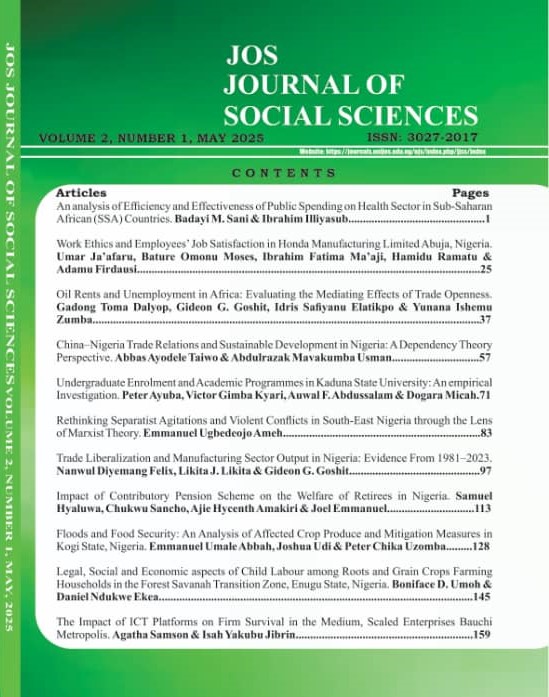
OIL RENTS AND UNEMPLOYMENT IN AFRICA: EVALUATING THE MEDIATING EFFECTS OF TRADE OPENNESS
Keywords:
Oil rents, Trade openness, Unemployment, Africa, JEL Classification: E24; F41; O13; O55; Q35; Q37Abstract
The persistence of high unemployment in some African countries necessitates this evaluation of the mediating effects of trade openness in the oil rents and unemployment relationship in oil rent receiving Africa countries. Using the two-step system generalized method of moments on data for 27 of these countries from 2000 to 2023, this study analysed interactions of oil rents and different measures of trade openness. The analysis found a significant inverse relationship between oil rents and unemployment. However, the respective interactions of the total trade and import measures of trade openness with oil rents indicated significant direct relationships with unemployment. The study, therefore, concluded that while oil rents are associated with lower unemployment in oil rent receiving countries in Africa, the outcome is not necessarily the result of openness to trade, as openness to trade, especially import trade, in fact, increases unemployment among these countries. The formation of capital through investment of rents is the more plausible means for reducing unemployment. The study, therefore, recommended the investment of oil rents in building infrastructure to enhance the growth of gross fixed capital formation and foreign direct investments. To achieve this, improvements in transparency and accountability in public finance should be encouraged.References
Abdul-Mumuni, A., Amakye, K., Abukari, A.-L. & Insaidoo, M. (2023). Modeling trade openness-unemployment nexus in sub-Saharan Africa: the role of asymmetries. African Journal of Economic and Management Studies, 14(4), 792–805. https://doi.org/10.1108/AJEMS-02-2023-0040
Ali, S., Yusop, Z., Kaliappan, S. R., Chin, L., & Meo, M. S. (2023). Impact of trade openness, human capital, public expenditure and institutional performance on unemployment: evidence from OIC countries. International Journal of Manpower, 43(5), 1108–1125. https://doi.org/10.1108/IJM-10-2020-0488
Alozie, S. T., Nwaiwu, B. N., & Iwueke, O. C. (2017). Determinants of unemployment in Nigeria. International Journal of Innovative Research in Social Sciences & Strategic Management Techniques, 4(1), 22–34. https://internationalpolicybrief.org/wp-content/uploads/2023/10/ARTICLE3-21.pdf
Amahalu, N. N., & Okafor, C. C. (2023). Tax revenue and gross fixed capital formation of Nigeria. International Journal of Research Publication and Reviews, 4(3), 4935–4942. Retrieved on May 23, 2025, from https://ijrpr.com/uploads/V4ISSUE3/IJRPR10928.pdf
Arellano, M., & Bond, S. (1991). Some tests of specification for panel data: Monte Carlo evidence and an application to employment equations. The Review of Economic Studies, 58(2), 277–297. https://doi.org/10.2307/2297968
Azeng, T. F., & Yogo, T. U. (2013). Youth unemployment and political instability in selected developing countries. African Development Bank Group Working Paper No. 171. Retrieved on May 25, 2025, from https://www.afdb.org/fileadmin/uploads/afdb/Documents/Publications/Working_Paper_171_-_Youth_Unemployment_and_Political_Instability_in_Selected_Developing_Countries.pdf
Azolibe, C. B., Dimnwobi, S. K., & Uzochukwu-Obi, C. P. (2022). The determinants of unemployment rate in developing economies: Does banking system credit matter? African Governance and Development Institute (AGDI), Yaoundé, Working Paper, No. WP/22/044. https://www.econstor.eu/bitstream/10419/269051/1/1809124778.pdf and https://hdl.handle.net/10419/269051
Baidoo, D. A. (2022). Do oil rents affect unemployment rates in net oil exporting African countries? International Journal of Economic Studies and Management (IJESM), 2(6). https://doi.org/10.5281/zenodo.7486579
Beblawi, H. (1987). The rentier state in the Arab world. Arab Studies Quarterly, 9(4), 383–398.
Chen, F., Xu, J., Zhang, W., Wei, B., & Li, T. (2023). Capital formation and natural resources extraction: A source of sustainable development or a curse for the economy? Resources Policy, 85(B), 103964. https://doi.org/10.1016/j.resourpol.2023.103964.
Chike, O. K., & Okeke, C. T. (2024). Assessing the impact of foreign direct investment on unemployment rate in Nigeria. Asian Journal of Economics, Business and Accounting, 24(4), 260–277. https://doi.org/10.9734/ajeba/2024/v24i41278
Chuku, C. A., Effiong, E. L., & Sam, N. R. (2010). Oil price distortions and their short- and long-run impacts on the Nigerian economy. MPRA Paper No. 24434. Retrieved on June 6, 2025, from https://mpra.ub.uni-muenchen.de/24434/1/MPRA_paper_24434.pdf
Cuevas Ahumada, V. M., & Calderón Villarreal, C. (2022). Oil rents, institutional development, and total factor productivity. Investigación Económica, 81(322), 52–72. https://doi.org/10.22201/fe.01851667p.2022.322.82218
Dalyop, G. T. (2023). Resource rents, taxation and political instability in Africa. In C. Obiageli, I. Ukwuoma, & N. Ogwo (Eds.), Studies in State and Security, 89–118. Kaduna: Centre for Critical Thinking, Teaching and Learning (CCTTL), Nigerian Defence Academy.
Daude, C., Gutiérrez, H., & Melguizo, Á. (2012). What drives tax morale? OECD Development Centre Working Paper No. 315.
Domar, E. D. (1946). Capital expansion, rate of growth, and employment. Econometrica, 14(2), 137–147.
Edwards, E. O. (1959). Classical and Keynesian employment theories: A reconciliation. The Quarterly Journal of Economics, 73(3), 407–428. https://doi.org/10.2307/1880612
Gonese, D., Sibanda, K., & Ngonisa, P. (2023). Trade openness and unemployment in selected Southern African Development Community (SADC) countries. Economies, 11(10), 252. https://doi.org/10.3390/economies11100252
Gozgor, G. (2014). The impact of trade openness on the unemployment rate in G7 countries. The Journal of International Trade & Economic Development, 23(7), 1018–1037. https://doi.org/10.1080/09638199.2013.827233
Harrod, R. F. (1939). An essay in dynamic theory. The Economic Journal, 49(193), 14–33. https://doi.org/10.2307/2225181
Hjazeen, H., Seraj, M. & Ozdeser, H. (2021). The nexus between the economic growth and unemployment in Jordan. Future Business Journal, 7(42). https://doi.org/10.1186/s43093-021-00088-3
James, A., (2015). US State fiscal policy and natural resources. American Economic Journal: Economic Policy, 7(3), 238–257. https://doi.org/10.1257/pol.20130211
Keynes, J. M. (1936). The General Theory of Employment, Interest and Money. Cambridge: Cambridge University Press.
Kpognon, K., Ondoa, H. A., & Bah, M. (2020). Trade openness and youth employment in sub-Saharan Africa: Should we regulate the labor market? Journal of Economic Integration, 35(4), 751–777. https://doi.org/10.11130/jei.2020.35.4.751
Krugman, P. R. (1980). Increasing returns, monopolistic competition, and international trade. Journal of International Economics, 9(4), 469–479. https://doi.org/10.1016/0022-1996(80)90072-5
Kurose, K., & Yoshihara, N. (2018). The Heckscher—Ohlin—Samuelson Trade Theory and the Cambridge Capital Controversies: On the validity of Factor Price Equalisation Theorem. Institute of Economic Research Hitotsubashi University Discussion Paper Series A No. 686. Retrieved on August 31, 2024, from https://www.ier.hit-u.ac.jp/Common/publication/DP/DPS-A686.pdf
Liu, Z., Ngo, T. Q., Saydaliev, H. B., He, H., & Ali, S. (2022). How do trade openness, public expenditure and institutional performance affect unemployment in OIC countries? Evidence from the DCCE approach. Economic Systems, 46(4), 101023. https://doi.org/10.1016/j.ecosys.2022.101023
Malicha, W. (2018). Oil rents management and distribution in the global south. Advances in Social Sciences Research Journal, 5(8), 464–474. https://doi.org/10.14738/assrj.58.4735
Matallah, S., & Matallah, A. (2016). Oil rents and economic growth in oil-abundant MENA countries: Governance is the trump card to escape the resource trap. Topics in Middle Eastern and African Economies, 18(2), 87–116. Retrieved on May 25, 2025, from https://meea.sites.luc.edu/volume18/pdfs/25-Oil%20Rents%20and%20Economic%20Growth%20in%20Oil-Abundant%20MENA%20Countries.pdf
Nurkse, R. (1953). Problems of capital formation in underdeveloped countries. Oxford University Press.
Ofori-Sasu, D., Adu-Darko, E., Asamoah, M. E., & Abor, J. Y. (2023). Oil rents, trade environment and financial development: An international evidence. Resources Policy, 82, 103492. https://doi.org/10.1016/j.resourpol.2023.103492.
Ogbeide, F. I., Kanwanye, H., & Kadiri, S. (2015). The determinants of unemployment and the question of inclusive growth in Nigeria: Do resource dependence, government expenditure and financial development matter? Montenegrin Journal of Economics, 11(2), 49–64. https://doi.org/10.14254/1800-5845.2015/11-2/3
Okun, A. M. (1962). Potential GNP: Its Measurement and Significance. In Proceedings of the Business and Economic Statistics Section of the American Statistical Association. Alexandria, VA, 89–104. American Statistical Association.
Pasara, M. T., & Garidzirai, R. (2000). Causality effects among gross capital formation, unemployment and economic growth in South Africa. Economies, 8, 26. https://doi.org/10.3390/economies8020026
PwC. (2025). Nigeria: Taxes on corporate income. Retrieved on May 23, 2025, from https://taxsummaries.pwc.com/nigeria/corporate/taxes-on-corporate-income#:~:text=Petroleum%20profit%20tax%20(PPT)&text=65.75%25%20for%20non%2DPSC%20operations,30%25%20for%20upstream%20gas%20profits.
Raifu, I. A., & Aminu, A. (2022). Impact of oil revenue on unemployment in Nigeria: Evidence from ARDL and quantile regression methods. The Journal of Energy and Development, 47(1/2), 101–134. http://dx.doi.org/10.2139/ssrn.4303859 or https://ssrn.com/abstract=4303859
Rosenstein-Rodan, P. N. (1943). Problems of industrialisation of eastern and south-eastern Europe. The Economic Journal, 53(210/211), 202–211. https://doi.org/10.2307/2226317
Rosenstein-Rodan, P. N. (1984). Natura facit saltum: Analysis of the disequilibrium growth process. In G. M. Meier, & D. Seers (Eds.), Pioneers in Development, 205–221. The World Bank & Oxford University Press.
Rosser, A. (2006). The political economy of the resource curse: A literature survey. IDS Working Paper 268. Retrieved on August 6, 2016, from http://r4d.dfid.gov.uk/PDF/Outputs/futurestate/wp268.pdf
Siddiqui, K. (2018). David Ricardo’s comparative advantage and developing countries: Myth and reality. International Critical Thought, 8(3), 426–452. https://doi.org/10.1080/21598282.2018.1506264
Stevens, P., & Dietsche, E. (2008). Resource curse: An analysis of causes, experiences and possible ways forward. Energy Policy, 36, 56–65. https://doi.org/10.1016/j.enpol.2007.10.003
Timba, G. T., Djamen, B. L., & Meka’a, C. B. (2025). The impact of oil rent on income inequality in sub-Saharan African countries: role of political institutions. Journal of Social and Economic Development. https://doi.org/10.1007/s40847-025-00419-y
Ulima, A. O. (2022). Does trade openness foster unemployment? Evidence from D-8 OIC countries. Muslim Business and Economic Review, 1(1), 43–62. Retrieved on May 27, 2025, from https://dev-journal.uiii.ac.id/index.php/mber/article/view/28/32
Wang, Y., Li, X., & Zhao, Y. (2024). Measuring income group heterogeneous treatment effect of trade openness on unemployment rate at country-year level. Journal of Knowledge Learning and Science Technology, 2(3), 366–380. https://doi.org/10.60087/jklst.vol2.n3.p380
Weinthal, E., & Luong, P. J. (2006). Combating the resource curse: an alternative solution to managing mineral wealth. Perspectives on Politics, 4(1), 35–53.
World Bank. (2025). World development indicators. Retrieved on May 18, 2025, from https://databank.worldbank.org/source/world-development-indicators
Downloads
Published
Issue
Section
License
Copyright (c) 2025 JOS JOURNAL OF SOCIAL SCIENCES

This work is licensed under a Creative Commons Attribution-NonCommercial-ShareAlike 4.0 International License.
