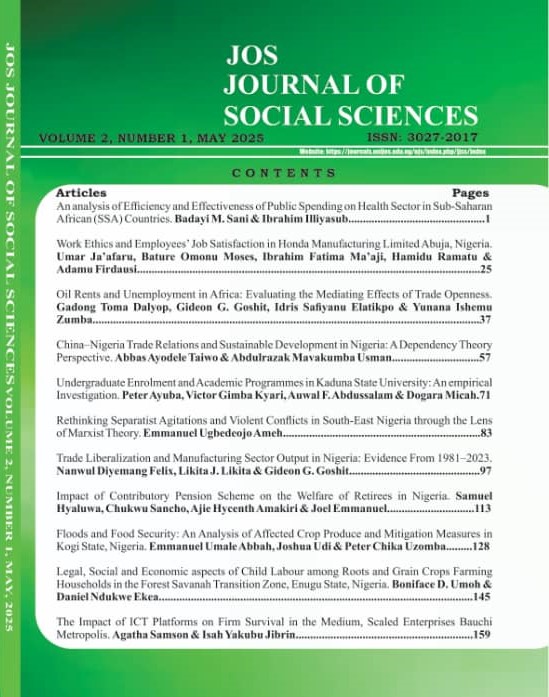
THE IMPACT OF ICT PLATFORMS ON SURVIVAL OF MEDIUM-SCALED ENTERPRISES IN BAUCHI METROPOLIS
Keywords:
ICT adoption, Firm survival, Medium-scaled enterprises, ICT infrastructure and ICT policiesAbstract
The increasing reliance on Information and Communication Technology (ICT) platforms has significantly influenced the survival and growth of medium-scaled enterprises (MSEs). This study examined the impact of access to ICT infrastructure, ICT adoption, and policies regulating ICT on firm survival among Medium-Scaled Enterprises in Bauchi Metropolis. Using a quantitative approach, data were collected from registered MSEs and analysed using Spearman Rank Order Correlation and multivariate analysis. The findings revealed strong positive correlation between access to ICT infrastructure and firm survival. ICT adoption was also found to significantly enhance business agility, operational efficiency, and market expansion. Additionally, well-structured policies regulating ICT contributed to a secure and enabling environment that fosters digital transformation and business sustainability. The study recommended increased investment in ICT infrastructure, enhanced digital literacy training for entrepreneurs, and policy frameworks that encourage innovation while ensuring data security. These measures will enable MSEs to leverage ICT platforms for long-term growth and survival in an increasingly digital economy.References
Adebayo, O. S., & Ajayi, V. O. (2021). ICT adoption and digital transformation in Nigerian MSMEs: A review of literature. Nigerian Journal of Management Sciences, 19(2), 78–93.
Adejuwon, F. E., & Ojeagbase, I. O. (2023). Role of cybersecurity education in promoting ethical and responsible use of technology for sustainable development. In Lead City University Postgraduate Multidisciplinary Conference Proceedings, 1(3), 163-186.
Adeola, O., & Evans, O. (2023). Digital policy, innovation, and enterprise sustainability in Africa. Journal of African Business, 24(1), 112–130.
Akinbami, F., & Bello, R. A. (2022). ICT policy framework and SME digitalization in Nigeria: Challenges and prospects. African Journal of Information Systems, 14(2), 55–72.
Allahrakha, N. (2023). Balancing cyber-security and privacy: legal and ethical considerations in the digital age. Legal Issues in the Digital Age, (2), 78–121.
Arinzeh, I. F. (2022). Microcredit loan accessibility and its effect on the performance of small and medium-sized enterprises (SMEs) in the Niger Delta Region of Nigeria.
Arvin, M. B., Pradhan, R. P., & Nair, M. (2021). Uncovering interlinks among ICT connectivity and penetration, trade openness, foreign direct investment, and economic growth: The case of the G-20 countries. Telematics and Informatics, 60, 101567.
Awad, A., & Albaity, M. (2022). ICT and economic growth in Sub-Saharan Africa: Transmission channels and effects. Telecommunications Policy, 46(8), 102381.
Banda, H. (2022). The effects of mobile money banking on the financial performance in selected micro and small enterprises in Lusaka, Zambia (Doctoral dissertation, The University of Zambia).
Bechara, F. R., & Schuch, S. B. (2021). Cybersecurity and global regulatory challenges. Journal of Financial Crime, 28(2), 359–374.
Brynjolfsson, E., & McAfee, A. (2021). The Second Machine Age: Work, Progress, and Prosperity in a Time of Brilliant Technologies. W. W. Norton & Company.
Caldeira, M. M., & Ward, J. M. (2023). Using resource-based theory to interpret the successful adoption and use of information systems and technology in manufacturing small and medium-sized enterprises. European Journal of Information Systems, 32(1), 55–74.
Caldeira, M. M., & Ward, J. M. (2023). Using resource-based theory to interpret the successful adoption and use of information systems and technology in manufacturing small and medium-sized enterprises. European Conference on Information Systems (ECIS) Proceedings, 1159–1170.
Federal Ministry of Communications and Digital Economy. (2020). National Digital Economy Policy and Strategy (2020–2030). Abuja, Nigeria: Government of Nigeria.
Guo, F., Li, Y., Maruping, L. M., & Masli, A. (2023). Complementarity between investment in information technology (IT) and IT human resources: implications for different types of firm innovation. Information Systems Research, 34(3), 1259–1275.
Harvard Business Review. (2022). How Digital Transformation Enabled Firms to Survive COVID-19. Harvard Business School Publishing.
Harvard Business Review. (2022). Technology and Resilience: How Digital Capabilities Supported Business Continuity During COVID-19. Retrieved from www.hbr.org
He, X., Sun, L., & Zhang, Y. (2024). Digital resilience and recovery among SMEs: A post-pandemic analysis. Journal of Small Business Management, 62(2), 113–130.
Hokmabadi, H., Rezvani, S. M., & de Matos, C. A. (2024). Business resilience for small and medium enterprises and startups by digital transformation and the role of marketing capabilities—A systematic review. Systems, 12(6), 220.
Imwiko, N. (2024). Assessing the uptake of digital financial service (DFS) by micro, small and medium-sized enterprises (MSMEs) in cross border trading in Zambia (Doctoral dissertation, The University of Zambia).
Karim, F., Nahar, L., & Demirbag, M. (2022). ICT capabilities and SME performance: Evidence from Sub-Saharan Africa. Information Systems Journal, 32(3), 285–309.
Karim, M. S., Nahar, S., & Demirbag, M. (2022). Resource-based perspective on ict use and firm performance: A meta-analysis investigating the moderating role of cross-country ICT development status. Technological Forecasting and Social Change, 179, 121626.
Kero, C. A., & Bogale, A. T. (2023). A systematic review of resource-based view and dynamic capabilities of firms and future research avenues. International Journal of Sustainable Development and Planning, 18(10), 2734–2748.
Komakecha, R. A., Ombati, T. O., Kikwatha, R. W., & Wainaina, M. G. (2024). Resource-based view theory and its applications in supply chain management: A systematic literature review. Management Science Letters, 14(1), 123–138.
Kurniawati, M. A. (2022). Analysis of the impact of information communication technology on economic growth: empirical evidence from Asian countries. Journal of Asian Business and Economic Studies, 29(1), 2–18.
M Omar, A. (2024). Exploring the Relationship between Digital Transformation and Effective Strategic Decision-making in the Egyptian Banking Sector, 15(4), 189–226.
McGahan, A. M. (2021). Integrating insights from the resource-based view of the firm into the new stakeholder theory. Journal of Management, 47(7), 1734–1756.
Muathe, J. M. (2021). Influence Of Mobile Banking Services on Growth of Micro and Small Enterprises in Makueni Sub-county in Kenya (Doctoral dissertation, Kca University).
Nchake, M. A., & Shuaibu, M. (2022). Investment in ICT infrastructure and inclusive growth in Africa. Scientific African, 17, e01293.
Ngwu, R. O., Onodugo, V. A., Monyei, F. E., Ukpere, W. I., Onyekwelu, P. N., & Mmamel, U. G. (2023). The nexus between industrial parks and the sustainability of small and medium-scaled ventures. Sustainability, 15(12), 9529.
OECD. (2022). The Digital Transformation of SMEs: Trends and Policies. Organisation for Economic Co-operation and Development Publishing.
Otokiti, B. O., Igwe, A. N., Ewim, C. P., Ibeh, A. I., & Sikhakhane-Nwokediegwu, Z. (2022). A framework for developing resilient business models for Nigerian SMEs in response to economic disruptions. Int J Multidiscip Res Growth Eval, 3(1), 647–659.
Pradhan, R. P., Arvin, M. B., & Nair, M. (2021). Urbanization, transportation infrastructure, ICT, and economic growth: A temporal causal analysis. Cities, 115, 103213.
Salunkhe, U., Rajan, B., & Kumar, V. (2023). Understanding firm survival in a global crisis. International Marketing Review, 40(5), 829–868.
Shoraevna, Z., Eleupanovna, Z., Tashkenbaevna, S., Zulkarnayeva, Z., Anatolevna, L., & Nurlanbekovna, U. (2021). Teachers’ views on the use of Information and Communication Technologies (ICT) in education environments. International Journal of Emerging Technologies in Learning (iJET), 16(3), 261–273.
Siuko, V. Developing Information Activities for Decision Making in Digitally Transforming Asset Lifecycle.
Stephen, B. K., & Matti, R. E. (2024). Digital Transformation and Middle Manager’s Strategic and Decision-Making Roles.
Sun, L., He, H., Yue, C., & Lin, W. (2024). Unleashing competitive edge in the digital era: Exploring information interaction capabilities of emerging smart manufacturing enterprises. Journal of the Knowledge Economy, 15(3), 10853–10897.
Supangkat, S. H., Firmansyah, H. S., Rizkia, I., & Kinanda, R. (2025). Challenges in Implementing Cross-Border Digital Identity Systems for Global Public Infrastructure: A Comprehensive Analysis. IEEE Access.
Suriyankietkaew, S. (2023). Effects of key leadership determinants on business sustainability in entrepreneurial enterprises. Journal of Entrepreneurship in Emerging Economies, 15(5), 885–909.
Tiwari, S. P. (2022). Information and communication technology initiatives for knowledge sharing in agriculture. arXiv preprint arXiv:2202.08649.
UNCTAD. (2022). Digital Economy Report 2022: Cross-Border Data Flows and Development. United Nations Conference on Trade and Development.
Wang, S., Jiang, X., & Khaskheli, M. B. (2024). The Role of Technology in the Digital Economy’s Sustainable Development of Hainan Free Trade Port and Genetic Testing: Cloud Computing and Digital Law. Sustainability, 16(14), 6025.
Yang, F., Luo, C., & Pan, L. (2024). Do digitalization and intellectual capital drive sustainable open innovation of natural resources sector? Evidence from China. Resources Policy, 88, 104345.
Downloads
Published
Issue
Section
License
Copyright (c) 2025 JOS JOURNAL OF SOCIAL SCIENCES

This work is licensed under a Creative Commons Attribution-NonCommercial-ShareAlike 4.0 International License.
