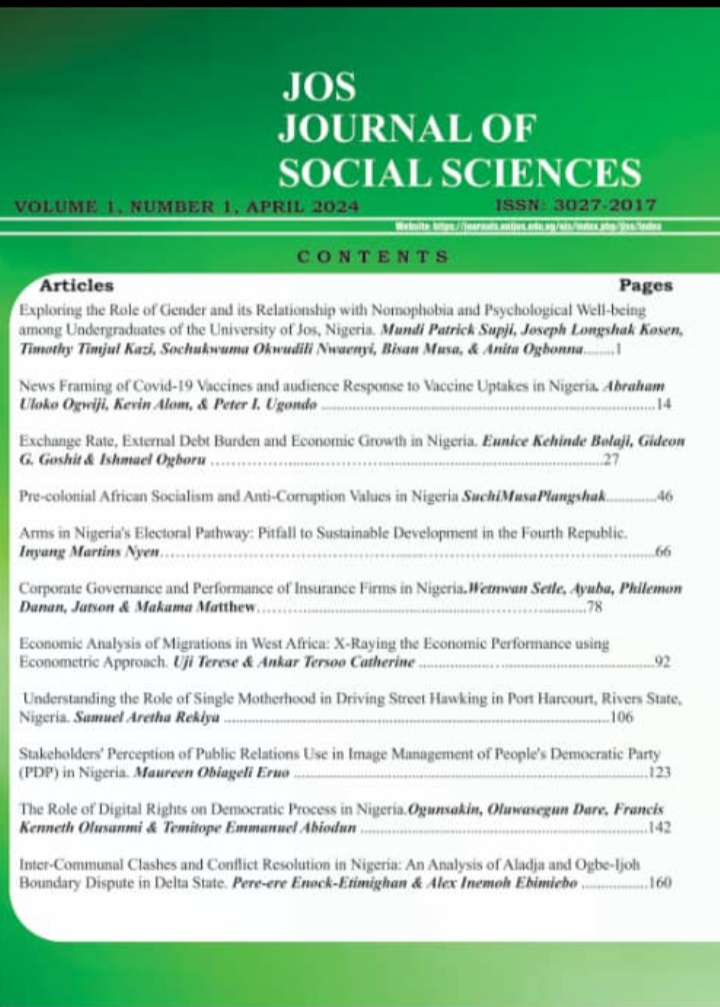
EXCHANGE RATE, EXTERNAL DEBT BURDEN AND ECONOMIC GROWTH IN NIGERIA
Keywords:
Exchange Rate, Economic Growth, External Debt, Burden and ARDLAbstract
The introduction of the Structural Adjustment Programme in Nigeria in 1986 was a pivotal moment that contributed to the country's excessive reliance on foreign debt to bridge the gap between savings and investment. Given that this obvious problem emanated from the humongous accumulation of debt and the likely effect of the exchange rate on it, this study examined exchange rate and the relationship between external debt burden and economic growth in Nigeria. To achieve this, the study employed the Autoregressive Distributive Lag Model (ARDL) for its analysis. The result indicated that interacting exchange rate with the external debt burden (ratio
of external debt burden to oil revenue) hurts the economic growth of the country. Hence, it was suggested as a way forward the need for the government to fully diversify the economy from the oil sector to the non-oil sector through policy implementation so that the country's economy can gain extensively from the revenue generation in the non-oil sector.
References
Aderemi, T. A. Fagbola, L. O., Sokunbi, G. M & Ebere, C. E. (2020). Investigating
External debt and Exchange rate fluctuations in Nigeria: Any difference with
the ARDL model? Studia Universitatis Babeș-Bolyai Oeconomica, 65(3),
-64.
Adidigba, A. P. (2019). External Debt, Exchange Rate, Foreign Investments, and
Economic Growth Inter-Relationships Further Empirical Evidence from
Nigeria. Asian Journal of Economics and Empirical Research, 6(2), 101-
Alagoa, S. C., Ifionu, E. P., & Ogunbiyi, S. S. (2023). Debt Burden and Economic
Stability in Nigeria. Central Asian Journal of Innovation on Tourism and
Management and Finance, 4(1),86-93.
Anderu, K. S. & Adeleke, O. (2019). External Debt and Economic Growth in
Nigeria. Journal of African Union Studies, 8(3), 157-171.
Anyanwu, J. C., (1993). Monetary Economics: Theory policy and institution.
Onitsha: Hybrid Publishers Ltd.
Aremu, J. A. (2005). Paper Delivered at a Workshop on Foreign Investment Policy
and Practice Organized by the Nigerian Institute of Advanced Legal Studies,
Lagos.
Ayadi, F. S., & Ayadi, F. O. (2008). The impact of external debt on economic growth:
A comparative study of Nigeria and South Africa. Journal of sustainable
development in Africa, 10(3), 234-264.
Djalo, M. U., Yusuf, M., & Pudjowati, J. (2023). The Impact of Foreign Debt on
Export and Import Values, The Rupiah Exchange Rate, and the Inflation
Rate. Jurnal Ekonomi, 12(01), 1124–1132.
Dos Santos, T. (1970). The Structure of Dependence. The American Economic
Review, 60(2), 231–236.
Epaphra, M., & Mesite, M. (2021). The external debt burden and economic growth in
Africa: a panel data analysis. Theoretical and Applied Economics, 28(2);
-206.
Emmanuel, A. (1972). Unequal Exchange: A Study of the Imperialism of Trade.
Monthly Review Press.
Kouladoum, J. C. (2018). External debts and real exchange rates in developing
countries: evidence from Chad.
Moazzam, M. D. (2022). External Debt and Real Exchange Rate Volatility in South
Asia. Sage Journal, 2(1), 54-67.
Obademi, O. E. (2012). An empirical analysis of the impact of public debt on
economic growth: Evidence from Nigeria. Canadian Social Science, 8(4),
–161 Ohiomu, S. (2020). External Debt and Economic Growth Nexus: Evidence from
Nigeria. The American Economist, 1-14
Olarinde, M. O., & Jonathan, J. M (2021). The Impact of Corruption on
Economic Growth in Nigeria. Journal of Asian Development, 7(2), 27–50.
Saheed, Z. S., Sani, I. E., & Idakwoji, B. O. (2015). Impact of public external debt on
the exchange rate in Nigeria. International Finance and Banking, 2(1), 15-26.
Zahra, A., Nasir, N., Rahman, S., & Idrees, S. (2023). Impact of Exchange Rate, and
Foreign Direct Investment on External Debt: Evidence from Pakistan Using
ARDL Cointegration. iRASD Journal of Economics, 5(1), 52-62.