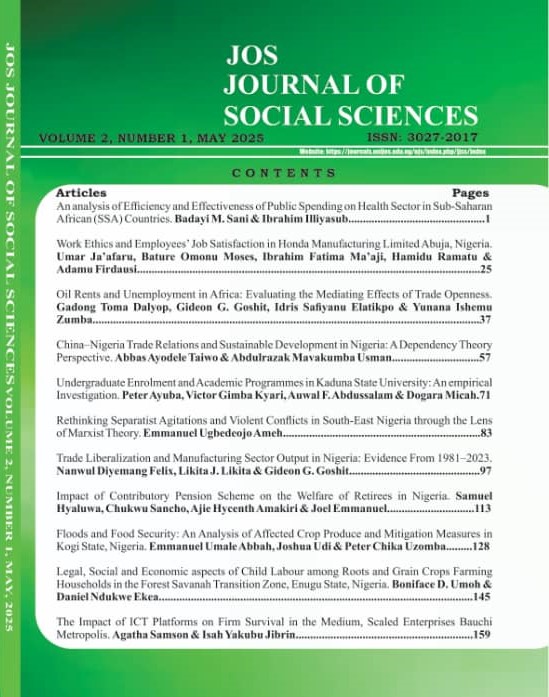
FLOODS AND FOOD SECURITY: AN ANALYSIS OF AFFECTED CROP PRODUCE AND MITIGATION MEASURES IN KOGI STATE, NIGERIA
Keywords:
Floods, Food security, Crop produceAbstract
This study aimed at analysing the effects of floods on food security with particular focus on crop produce as well as mitigating efforts in Kogi State, Nigeria. The two research questions and one null hypothesis that guided the study were analysed using data gathered with a research instrument from 45 farmers who were affected by floods between 2012 and 2022. Using percentage, frequency, mean, standard deviation, skewness and kurtosis for the research question, and chi-square logistic likelihood ratio inferential statistics for the null hypothesis, the analysis revealed that cereal grains, fruits, pulses (legumes), vegetables, tuber crops, spices and herbs, oil-seed and fiber crops were affected by floods. The study dropped the null hypothesis – which suggested that there is significant difference between the observed and expected values of the two categories (floods and food security). Accordingly, the study concluded that floods did extremely affect crop produce and the farmers have made mitigation efforts, but they have been considerably inadequate; hence desirable results have not been achieved. It is therefore, recommended that governments at all levels as well as non-governmental organizations should make strategic efforts in mitigating the effects of floods on food security.References
Abbah, E. U., Udeh, J. E., Mancha, M., & Musa, D. O. (2023). Climate change and sustainable development in Nigeria: Kogi State in Perspective. Northwest Journal of Social and Management Sciences, 4(1), 35–45.
Abid, M., Schneider, U. A., & Scheffran, J. (2016). Adaptation to climate change and its impacts on food productivity and crop income: Perspectives of farmers in rural Pakistan. Journal of Rural Studies, 47, 254–266.
Agba, F. K., Adewara, D. H., Adama, S. H., Adzer, K. W., & Atoyebi, G. L. (2017). Analysis of the effects of climate change on crop output in Nigeria. American Journal of Climate Change, 554–571.
Alehile, G. K., Njiforti, A. G., Duru, H. Y., & Jibril, D. P. (2022). Floods and food security. Philosophical Transactions of the Royal Society B: Biological Sciences, 360(1463), 2139–2148.
Bodkin, F. H. (2019). Effects of global climate change on Nigerian agriculture: An empirical analysis. CBN Journal of Applied Statistics, 2(1), 31–50.
Bosello, A. J., Campagnolo, D. K., Cervigni, T. F., & Eboli, B. O. (2018). Challenges of agricultural adaptation to climate change in Nigeria: A synthesis from the literature. Field Actions Science Reports. The Journal of Field Actions, 4(6), 24–39.
Branca, D. K., Lipper, S. E., McCarthy, L. Y., & Jolejole, S. A. (2013). Effect of climatic variability on maize production in Nigeria. Research Journal of Environmental and Earth Sciences, 2(1), 19–30.
Bronfenbrenner, F. H. (2023). Assessing food security among young farmers in Africa: evidence from Kenya, Nigeria, and Uganda. Agricultural and Food Economic Review, 11(4), 45–63.
Ejemeyovwi, J., Obindah, G., & Doyah, T. (2018). Carbon dioxide emissions and crop production: finding a sustainable balance. International Journal of Energy Economics and Policy, 8(4), 303–309.
Eshete, D. G., Mulatu, F. D., & Gatiso, P. R. (2020). The impacts of climate change, carbon dioxide emissions (CO2) and renewable energy consumption on agricultural economic growth in South Africa: ARDL approach. International Journal of Sustainability, 14(24), 164–68.
FAO. (2015). Climate change and food security: risks and responses.
FAO. (2021). Climate-Smart livestock production: A practical guide for Asia and the Pacific region. Bangkok. https://doi.org/10.4060/cb3170en. from: https://data.worldbank.org/data-catalog/ world-development-indicators.
FAO (2021). The state of food security and nutrition in the World 2021. In the state of food security and nutrition in the World 2021. https://doi.org/10.4060/cb4474en
Gershon, G. P., & Mbajekwe, S. G. (2020). Effect of climate change on food security in Nigeria. Journal of Environmental Science, Computer Science and Engineering and Technology, 3(4), 1763–1778.
Idumah, Q. K., Mangodo, G. K., Ighodaro, G. T., & Owombo, Z. R. (2016). Implications of climate change on food security in Taraba South, Nigeria. European virtual conference on management science and economics, 3(8), 29–47.
Lone, L. H., Qayoom, U. D., Singh, S. P., Dar, N. C., Kumar, D. S., Fayaz, H. J., Ahmad, B. N., Lyaket, C. V., Bhat, E. Y., & Singh, D. A. (2017). Adaptation and climate change impacts: a structural Ricardian model of irrigation and farm income in Africa. Climate Change Economics, 2(2), 149–174.
Kogi State Ministry of Agriculture. (2020). Annual report.
Kurukulasuriya, W. K., Kala, G. L., & Mendelsohn, G. O. (2011). Climate change perception and its impact on net farm income of smallholder rice farmers in South-West, Nigeria. Journal of cleaner production, 3(10), 127-373.
Marie, A. K., Yirga, G. H., Haile, R. D., & Tquabo, B. S. (2020). Impacts of climate change on farm income security in Central Asia: An integrated modeling approach. Agriculture, ecosystems & environment, 18(8), 245–255.
Ojo, A. H., & Baiyegunhi, K. G. (2021). The effects of climate change and groundwater salinity on farmers’ income risk. International Journal of Environment and Sustainable Development, 16(1), 43–59.
Sarbu, D. H. (2000). Economic development. Edinburgh Gate, United Kingdom: Pearson Education, Inc.
Sen, H. (2023). Food security - a commentary: what is it and why is it so complicated? International Journal of Public Health and Foods, 1(1), 18–27.
Tagwi, V. B. (2022). Climate change and crop production in Nigeria: An error correction modelling approach. International Journal of Energy Economics and Policy, 4(2), 297–311.
Temple, G. H. (2018). Farmers' choices and factors affecting adoption of climate change adaptation strategies: evidence from northwestern Ethiopia. Journal of Heliyon, 6(4), 56–78.
Uger, G. Y. (2017). Food security indicators and framework for use in the monitoring and evaluation of food aid programs. Nutrition Technical Assistance Project (FANTA), Washington, DC.
Usha, M. L., & Ram, P. H. (2021). Investigating the nexus of climate change and agricultural production in Nigeria. International Journal of Energy Economics and Policy, 10(6), 1–8.
Downloads
Published
Issue
Section
License
Copyright (c) 2025 JOS JOURNAL OF SOCIAL SCIENCES

This work is licensed under a Creative Commons Attribution-NonCommercial-ShareAlike 4.0 International License.
